


Syllabus: GS2/Health
Context
- The recent Sample Registration Survey 2024 was released by the Office of the Registrar General of India (ORGI).
The Sample Registration System (SRS)
- It provides reliable annual estimates of Infant Mortality Rate, Birth Rate, Death Rate and other Fertility & Mortality Indicators at the National and subNational levels.
- It is a large-scale demographic survey conducted every year by the Office of the Registrar General of India in all States/Union Territories.
Major Findings
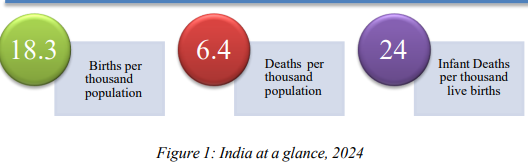
- Birth Rate: It is live births per 1,000 population, it fell from 21 in 2014 to 18.3 in 2024.
- The number declined from 14.9 to 14.7 in urban areas and from 20.3 to 20.2 in rural areas.
- The highest Birth Rate was observed at 26.8 in Bihar, whereas Andaman & Nicobar Islands had the lowest Birth Rate of 9.9.
- Death Rate: It is deaths per 1,000 people, it is down from 6.7 to 6.4.
- In 2024, Chhattisgarh recorded the highest Death Rate of 8.4, whereas the lowest Death Rate was recorded in Chandigarh at 3.9.
- Infant Mortality Rate: The Infant Mortality Rate (IMR) is the number of deaths of children under one year of age per 1,000 live births in a given year.
- The present level of IMR (24 infant deaths per thousand live births, for the year 2024) is less than one-fifth as compared to 1971. In the last ten years, IMR has witnessed a decline of about 38%.
- In 2024, the maximum IMR was reported in Chhattisgarh (36) and the minimum in Manipur (2).
Government Initiatives to Curb Infant Mortality in India
- Janani Shishu Suraksha Karyakram (JSSK) entitles all pregnant women and sick infants (up to one year of age) delivering in public health institutions to have free and no-expense delivery, including cesarean section.
- It includes free drugs, consumables, free diet during the stay, free diagnostics, free transportation, and free blood transfusion if required.
- Pradhan Mantri Surakshit Matritva Abhiyan (PMSMA) provides pregnant women a fixed day, free of cost, assured and quality antenatal checkup by a Specialist/Medical Officer on the 9th day of every month.
- Village Health Sanitation and Nutrition Days (VHSNDs) are observed for the provision of maternal and child health services and for creating awareness on maternal and child care.
- Reproductive and Child Health (RCH) portal is a web-enabled tracking system for pregnant women and newborns to ensure seamless provision of regular and complete services to them.
- Mother and Child Protection (MCP) Cards and Safe Motherhood Booklet are distributed to pregnant women to educate them on diet, rest, danger signs of pregnancy, benefit schemes, and institutional deliveries.
- Mission Indradhanush: It was launched in 2014, aiming to achieve over 90% full immunisation coverage by strengthening routine immunisation services and targeting hard-to-reach populations.
- Full immunisation coverage has risen from 62% in 2015 to 98.4% in 2026.
- Rashtriya Bal Swasthya Karyakram (RBSK): Children from 0 to 18 years of age are screened for 32 health conditions (i.e. Diseases, Deficiencies, Defects, and Developmental delays) under RBSK to improve child survival.
- Nutrition Rehabilitation Centres (NRCs) are established at public health facilities where children with Severe Acute Malnutrition (SAM) and medical complications are admitted for treatment.
Do You Know?
- India has eradicated smallpox, polio and maternal & neonatal tetanus through vaccination, and continues to expand its immunisation programme — most recently launched HPV and indigenous Td vaccines in 2026.
- The UIP is one of the world’s largest immunisation programmes, reaching 2.9 crore pregnant women and 2.54 crore newborns every year, free of cost.
Source: TH
Previous article
India’s Proposed Anti-Doping Law Amendments
Next article
Cyber Warfare and the Challenge to International Law
